Education Freedom Accounts
We're guiding TEFA implementation in Catholic schools, by providing support, regular updates and resources for parents and schools.
Texas Education Freedom Accounts
An affordable path for Texas Catholic families
The Texas Education Freedom Accounts (TEFA) program is a significant step forward in empowering families to tailor their children's education to their specific needs. TEFAs are publicly funded savings accounts that can be used for qualified educational expenses, including private and Catholic school tuition, uniforms, meals, textbooks, therapies, tutoring and more. The program prioritizes students with disabilities and low-income families, creating a pathway to Catholic education. Our Catholic schools are rooted in the teachings of Jesus Christ where students grow in faith and wisdom.
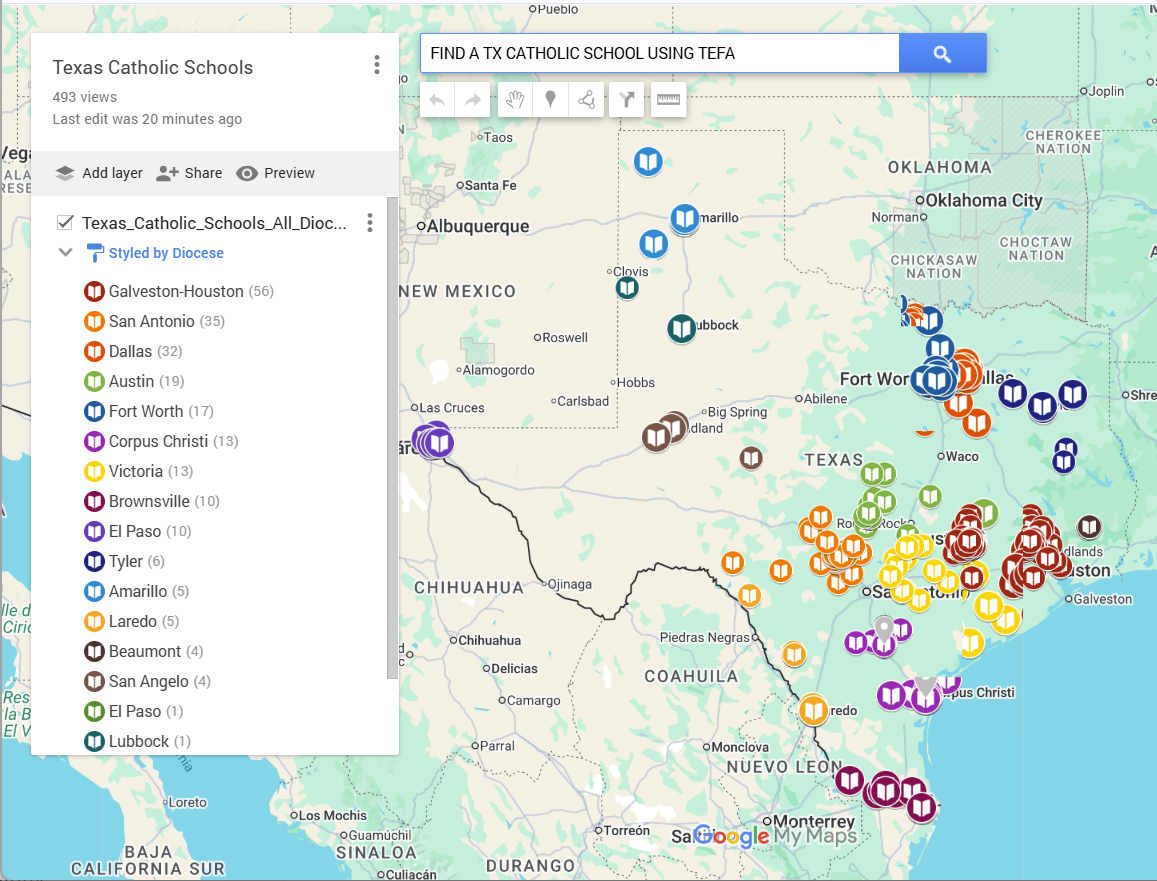
Find a Catholic school near you that is accepting TEFA funds!
Frequently Asked Questions
Parents of a child with special needs will be required to provide a Texas Student Unique Identifier (also known as a UID) for their child's application.
Your public school district (ISD) in which the IEP was created is the source for this number.
Your district should have this identifier on record even if your student has been attending private school.
Alternatively, parents of students who have ever attended a public school can visit this website to look up their student's UID. Click on the “Student Look Up” button at the top center of the page which will open a screen where you can submit your child’s first name, social security number, and date of birth. If your child has been registered in a public school, the website will provide their UID number.
Currently, this portal does not contain UID lookups for private school students with ISD IEPs. Private school student parents should contact the special education department of the ISD that completed your student’s IEP.
If your child has only attended private school, your local public school district should be able to enter your student's IEP information into TEA's APEX system on your behalf. This will allow them to provide you with a UID.
If you have exhausted all methods of obtaining a UID, then you may enter "11111" followed by your zip code in the application instead of the Texas Unique Student Identifier. This will allow you to continue with the application.
Please note that the only way to ensure additional SPED funding for TEFA is to have a validated IEP on file with TEA, which means the child has a valid Texas Unique Student Identifier (or UID).
For additional information on what special education criteria is applicable for additional funding and priority versus what special education criteria is applicable for only priority, please read this article.
The state has budgeted $1 billion, which will serve approximately 90,000 students. The amount available to each student is based on their circumstances:
- Participants choosing an approved private or Catholic school or a pre-K or Kindergarten program receive 85% of the estimated statewide average amount of state and local funding per student for the most recent school year, which is $10,474.
- A child with a disability may receive up to $30,000, according to the amount the child’s school district would receive if the child were enrolled in public school, based on the child’s individualized education program (IEP).
- Home-schooled participants receive $2,000.
Student must be a U.S. citizen, national, or lawful resident, be a resident of Texas and be eligible to attend a Texas public school or open-enrollment charter school, or eligible to attend a public or open-enrollment charter school's pre-K or Kindergarten program.
Students may apply for the EFA program while enrolled in a public or charter school, but, once accepted into the program, they cannot be enrolled full time in a public or charter school during the school year in which they use those funds.
If accepted into the program, the child will remain eligible to participate until the child graduates from high school, is no longer eligible to attend a Texas public school, charter school, or pre-K or kindergarten program, enrolls in a Texas public or charter school, or moves out of the state of Texas.
If a child is accepted for participation during an application period, any eligible sibling of that child who applies during the same application period is also accepted for participation during that application period.
Participants who remain in good standing do not need to reapply each year.
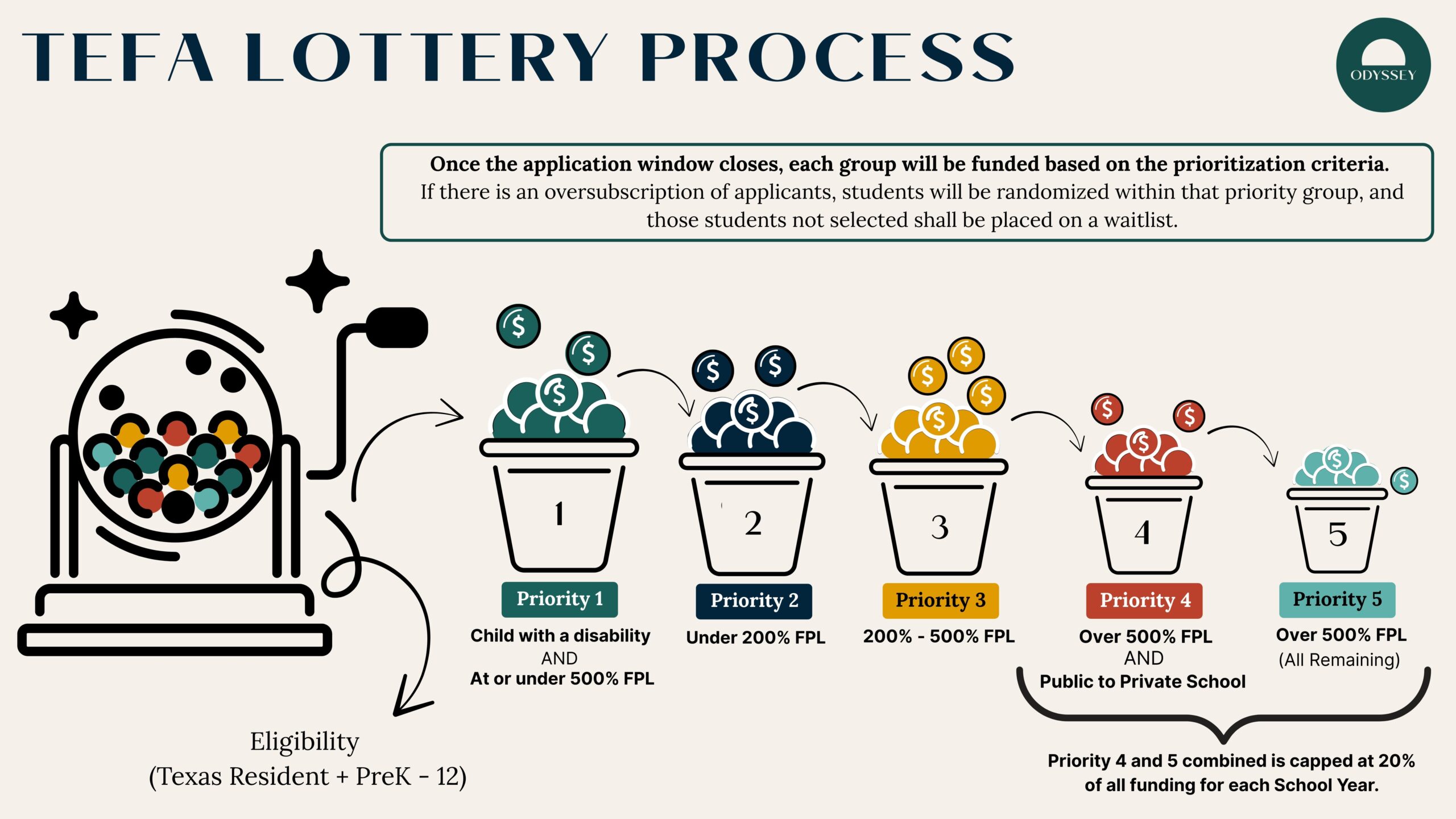
For the 2026-27 school year (year one), if applications exceed the limited number of available TEFAs, TEFAs will be given to families per the follow prioritization:
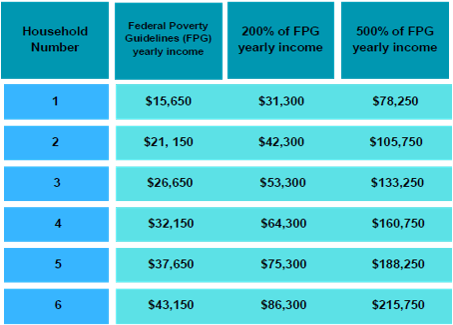
- Priority group 1 – children with disabilities who are members of a household whose total annual income is at or below 500% of the Federal Poverty Level Guidelines (FPG) (see chart)
- Priority group 2 – children who are members of a household whose total annual income is at or below 200% of the Federal Poverty Level Guidelines
- Priority group 3 – children who are members of a household whose total annual income is between 200% and 500% of the Federal Poverty Level Guidelines
- Priority group 4 – all other eligible children
- Group 4 prioritizes students switching from public school or charter school
- Funding for group 4 is capped at 20% of the total appropriation in the EFA program
After the 2026-27 school year, applicants will first be prioritized in the following order, and then will be prioritized within each group in the order stated in the year 1 prioritization:
- Siblings of participating children.
- New eligible program applicants.
- Prior program participants who ceased program participation due to enrollment in a public or charter school.
Note: Federal Poverty Level guidelines are set annually by the U.S. Department of Health and Human Services.
Participants who remain in good standing do not need to reapply each year.
A student may qualify as a child with a disability if they are at least three years old but not more than 21 years old and have one or more of the following conditions that prevent them from being adequately or safely educated in public school without special services:
- Visual or auditory impairment
- Physical disability
- Intellectual or developmental disability
- Emotional disturbance
- Learning disability
- Autism
- Speech disability
- Traumatic brain injury OR an Individual Education Plan (IEP)
One of the following documents is needed to prove a child with disabilities:
- A letter verifying the child’s eligibility to receive Supplemental Security Income (SSI) or Social Security Disability Insurance (SSDI), or
- A written diagnosis from a licensed physician verifying one of the listed disabilities, or
- An Individualized Education Program (IEP) issued by a Texas public school district or open-enrollment charter school.
A participating child between the ages of 3-5 is eligible for enrollment in a pre-K or Kindergarten program under this section if the child is at least three years of age and:
- is unable to speak and comprehend the English language;
- is eligible to participate in the national free or reduced-price lunch program;
- is homeless, regardless of the residence of the child, of either parent of the child, or of the child’s guardian or other person having lawful control of the child;
- is the child of an active-duty member of the armed forces of the United States, including the state military forces or a reserve component of the armed forces, who is ordered to active duty by proper authority;
- is the child of a member of the armed forces of the United States, including the state military forces or a reserve component of the armed forces, who was injured or killed while serving on active duty;
- is, or ever has been, in:
- the conservatorship of the Department of Family and Protective Services following an adversary hearing held as provided by Section 262.201, Family Code; or
- foster care in another state or territory, if the child resides in this state;
- is the child of a person eligible for the Star of Texas Award as:
- a peace officer under Section 3106.002, Government Code;
- a firefighter under Section 3106.003, Government Code; or
- an emergency medical first responder under Section 3106.004, Government Code; or
- is the child of a person employed as a classroom teacher at a public primary or secondary school in the school district that offers a pre-k or kindergarten class under this section.
- Tuition and fees for a private school, higher ed provider, online educational course or program, or a program that provides industry-based credential approved by TEA.
- Costs of breakfast or lunch provided during the school day by a private school.
- Purchase of instructional materials (including textbooks) or required uniforms.
- Fees for classes provided by school districts that do not qualify the child to be included in school’s average daily attendance.
- Costs related to academic assessments.
- Fees for private tutor or teaching service.
- Fees for transportation provided by a fee-for-service transportation provider.
- Fees for educational therapies or services not covered by government benefits or private insurance.
- Costs of computer hardware and software and other technological devices required by a provider or prescribed by a physician (not to exceed in any year 10% of the total amount in the child’s TEFA for the year).
- Money may not be used to pay any person related to a program participant within the third degree of consanguinity.
Funds remaining at the end of the school year will roll over as long as the child remains in the TEFA program.
Parents can submit an application on behalf of a child. Parent means a resident of this state who is a natural or adoptive parent, managing or possessory conservator, legal guardian, custodian, or other person with legal authority to act on behalf of a child.
Parents must agree to:
- Spend program money only for eligible expenses
- Share child's assessment results with Odyssey, the firm managing the TEFA program.
- Not sell an item purchased with program money and
- Notify Odyssey with in 30 days of child enrolling in public school, graduating high school, or otherwise becoming ineligible to enroll in public school
Families may sign up for updates from the Comptroller’s office.
- The parent of a child not enrolled in public school may request a school district evaluate a child for determining eligibility for special education services and participation in the TEFA program as a child with a disability. If the child is eligible, the school district must develop an Individualized Education Program (IEP) for the child.
- Odyssey, the certified education assistance organization, must provide notice to parents that a private school is not subject to federal and state laws regarding the provision of educational services to a child with a disability in the same manner as a public school.
- Odyssey must provide information regarding the rights to which a child with a disability is entitled if the child attends a public school.
- A public school must provide records to the parent of a child seeking to participate in the TEFA program or to a private school at the parent’s request.
- A school district, TEA, or charter school must provide information to Odyssey, the firm managing the TEFA program, to verify a child’s eligibility to participate in the TEFA program.
- Odyssey may not retain information beyond the period necessary to determine eligibility.
- Odyssey must comply with confidentiality laws and may not sell or distribute information without a participant’s consent.
The application period for private schools is expected to open on December 9, 2025. Private schools must be in Texas, accredited by an organization recognized by the Texas Private School Accreditation Commission or another accreditor recognized by the Texas Education Agency, and in continuous operation for at least two school years preceding the date of application.
They also must annually administer a nationally norm-referenced assessment to participating students in grades 3-12.
Providers can include:
1. A provider of supplemental special education services previously approved by TEA.
2. A private school:
- accredited by TEPSAC or TEA and
- annually administers a nationally norm-referenced assessment in grades 3-12 and
- has continuously operated a campus for at least two school years preceding the date the school seeks approval to participate in the program.
3. A school district or charter school accredited by TEA and able to provide services or products to participating children in a manner that the children are not counted toward average daily attendance.
4. A private tutor, therapist, or teaching service employee who:
- is an educator employed by or a retired educator formerly employed by a school accredited by TEA, or an organization recognized by TEA or TEPSAC or
- holds a relevant license or accreditation by a state, regional, or national certification or accreditation organization or
- is employed in or retired from teaching or tutoring capacity at a higher education provider and
- has provided a national criminal history record information review to the comptroller and is not on the Do Not Hire registry.
5. A higher education provider that demonstrates nationally recognized postsecondary education accreditation.
- An education service provider or vendor who receives TEFA money is not a recipient of federal financial assistance and may not be considered a state actor.
- The state may not impose limits or requirements contrary to religious or institutional values of a provider, vendor, or participant regarding curriculum, admissions practices, operations, policies, standards, etc.
- Quarterly transfers into TEFA accounts will be made on the first day of July, October, January, and April.
- If a child enrolls in the program after the beginning of the school year, the amount transferred is prorated based on the date of enrollment.
- Any money remaining in a participating child’s account will be carried over to the next fiscal year.
- Transfers to an account are not considered taxable income unless otherwise provided by federal or another state’s law.
Please contact the Catholic school of your preference and speak with the pastor or principal, who can assist you with information on available scholarships and/or financial assistance.
The Texas Comptroller of Public Accounts will oversee the program to ensure funds are used properly. Odyssey was selected as the certified educational assistance organization (CEAO) that will help with administration of the program under the Comptroller’s oversight.
Resources for schools, parishes and dioceses
TEFA Eligibility Guidelines
There are four categories of prioritization for applicants:
- Students with a disability
(defined by Texas Educ. Code Sec. 29.003) whose family income is at or below 500% of the Federal Poverty Guidelines (FPG) - see chart below. - Children whose family income is at or below 200% of the FPG.
- Children whose family income is between 201% and 500% of FPG
- Everyone else, depending upon available funds. Students who move from public schools will be prioritized over currently enrolled private school students in this category only.

Questions? Join our community and we'll send you important updates, too!
Thanks for your message! We'll add your email to our growing community interested in supporting parental choice through Education Savings Accounts.